Writing music is hard!
Writing code is fairly straightforward for me. As long as I know what I’m trying to do, I can gradually take steps towards a more correct version of the code. I have concrete goals I can use to evaluate the behavior of my code, so even if some parts of the problem solving process are less linear, I feel confident I’ll get where I need to go over time.
Writing music, especially choral music, is different. Sitting down to write a new piece of music is never straightforward, and I think it’s actually good that it isn’t.
To participate in any form of art that requires planning or design, you have to appreciate the possibility space of what you can do with your medium. For me, that’s choral music, but I think it applies equally to any deliberative art form.
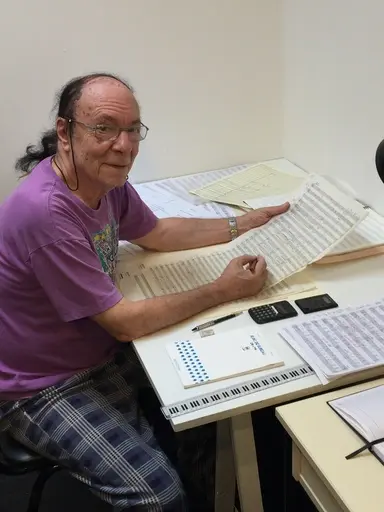
I know firsthand that the possibilities in choral music are vast. There are so many ways to handle melody, harmony, rhythm, texture, tone color, or even cross these categories into one another in ways that dissolve their conceptual boundaries.
What’s more, I don’t think a composer can just be satisfied to map out the possibility space as they know it and then go picking various points within that space. With each piece you write, you want to be finding ways to expand the space you know and go beyond it in some meaningful way. And for me personally, I think that kind of top-down approach would stifle my goal to find a soul for the particular piece I’m working on and let that soul lead the process.
One of the coolest things about art is that you are at liberty to set the goals, so one of your goals becomes figuring out what goals you want to set. This is why music remains unendingly challenging and interesting to me, and really why I like to do it: when the goalposts are your own evolving sense of taste, there’s no limit to how good you can get at it.
Do you write music?
Do you do any other deliberative kind of art?
Do you find it endlessly challenging?
Let me know your thoughts at my Ctrl-C email: gome @ ctrl-c.club.